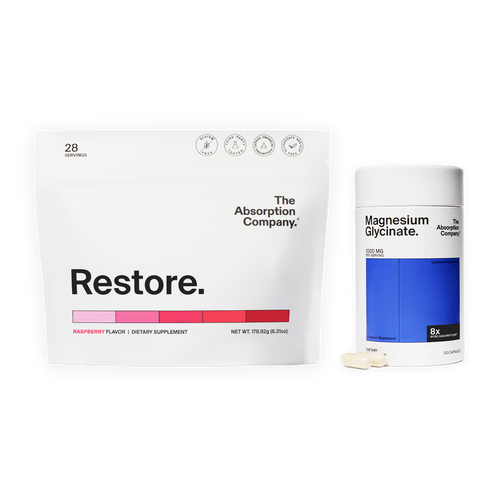
Can you take magnesium glycinate while pregnant? Yes, and the form you choose matters far more than most people are told. Magnesium glycinate while pregnant is widely regarded as one of the gentler, more bioavailable options, but "gentle" and "bioavailable" are two very different standards.
Here's the part that rarely gets discussed: most magnesium glycinate on the market is not what it claims to be. Many brands use a dry-blend process, mixing cheap magnesium oxide with glycine powder and labeling the result as "glycinate." The bonded molecule is never actually formed. Your body recognizes it as oxide, absorbs a fraction of it, and the rest moves through your GI tract, creating bloating, cramping, and the kind of bathroom urgency no pregnant person needs.
Our magnesium glycinate uses a fully reacted chelation process. The magnesium and glycine are chemically bonded into a new molecule, magnesium bisglycinate, in a controlled liquid environment, then wrapped in Capsoil® liposomal technology for a second layer of delivery. The result: 267% more absorbed than leading magnesium glycinates and 8x more than magnesium oxide.
Among the available forms, glycinate is one of the most well-tolerated, precisely because its absorption mechanism bypasses the laxative pathway that makes other forms so disruptive. All the benefits, none of the bathroom trips. That trade-off matters considerably more when you're already managing everything pregnancy brings.
Magnesium Glycinate Pregnancy Benefits: What Actually Changes When Your Body Absorbs It
Magnesium glycinate pregnancy benefits go well beyond a standard checklist. The real difference between taking magnesium and feeling magnesium comes down entirely to how much your body can absorb. When absorption is dialed in, these are the shifts that become more impactful.
Deeper, More Restorative Sleep Across All Three Trimesters
Pregnancy reshapes sleep in ways that catch many women off guard. Hormonal shifts, physical discomfort, and a nervous system running at higher output make deep rest harder to reach. Magnesium activates the neurotransmitters that help your brain and body downshift into recovery mode. Once your levels are where they need to be, lighter sleep and frequent waking can give way to longer, more restorative stretches. That alone changes how you feel the next day.
Fewer Muscle Cramps and Less Constant Physical Tension
Pregnancy restructures your body from the inside out. As your center of gravity shifts and your muscles work harder to carry a growing baby, cramping and tension become more frequent, particularly the nighttime leg cramps that interrupt sleep during the second and third trimesters. Magnesium plays a direct role in the muscle relaxation cycle, the recovery process that follows every contraction. When it's absorbed well, your muscles get the signal to release instead of staying locked up.
Quieter Nervous System and a More Steady Mood
Pregnancy can activate the stress response in ways that feel disproportionate to the moment. Magnesium is required for cortisol regulation and the neurotransmitter balance that keeps mood stable. When levels are consistently maintained, the difference is often described as a calmer internal baseline: less reactive, more grounded, fewer anxiety spikes that feel bigger than the situation warrants.
A Link Between Magnesium and Vitamin D During Pregnancy
Magnesium and vitamin D are metabolically dependent on each other. Without adequate magnesium, the body cannot properly convert vitamin D into its active, usable form. Low vitamin D is frequently a downstream symptom of low magnesium, and during pregnancy, both deficiencies carry real consequences. Taking vitamin D without sufficient magnesium means the conversion pathway stalls. You need both, and you need both absorbed.
More Consistent Energy, Without the Mid-Afternoon Crash
Energy dips during pregnancy are partly a magnesium story. Magnesium drives the production and regulation of ATP, the molecule powering nearly every cellular process in your body. When magnesium during pregnancy is absorbed at a meaningful rate, the result is steadier cellular energy output across the day rather than sharp highs that fade fast.
Is Magnesium Deficiency Common During Pregnancy?
Magnesium requirements rise during pregnancy by roughly 40mg per day above baseline. Diet alone rarely keeps pace, and the reasons run deeper than most nutrition advice acknowledges.
Modern farming has reduced magnesium concentrations in soil by up to 40% over the last 50 years. The vegetables and whole grains that once delivered reliable amounts now carry meaningfully less of the mineral. Eating well is still the right call, but the nutrient density has changed in ways that are easy to miss on a food label.
Add in the physical demands of pregnancy: regular workouts that increase sweating and mineral loss, digestive shifts that affect how nutrients are taken up, and the reality that your baby draws from your reserves before you do. The gap between what your body needs and what it receives can build quietly over weeks, with signals that look like ordinary pregnancy fatigue or mood variability.
Standard supplement advice tends to skip the most important part of this equation. A low-absorption magnesium is not closing that gap. More of something your body cannot use does not translate to more benefit. That's exactly why a solid magnesium glycinate absorption rate is built into our formula, verified at 64% bioavailable during lab testing.
How Much Magnesium to Take in Each Trimester: A Practical Action Plan
Magnesium needs shift as pregnancy progresses, and a trimester-aware routine produces better results than a fixed dose throughout. Here is how to approach each stage. Always confirm your specific amounts with your OB or midwife before starting.
First Trimester
Early pregnancy brings rapid internal change, often before any visible signs appear. General recommendations place daily intake around 310–320 mg during this stage, covering early cellular development, neurotransmitter regulation, and the fatigue and nausea that often define the first trimester. Starting a consistent routine now prevents the deficit from building quietly in the background.
Second Trimester
By the second trimester, the physical workload on your body has increased substantially. Muscle mass is adapting, blood volume is expanding, and your baby's skeletal development is accelerating. Daily intake recommendations generally rise to approximately 350–360 mg to keep pace with these demands. This is often the window where the difference between a high-absorption formula and a standard one moves from theoretical to felt.
Third Trimester
The third trimester places the highest physical demand on your body and nervous system. Daily intake in the 350–360 mg range remains the general recommendation, with a priority focus on muscle relaxation, sleep quality, and nervous system stability in the final weeks before delivery. A well-formulated magnesium glycinate taken daily during this stage can make a real difference in how your body manages tension and nighttime recovery. As always, your healthcare provider should guide your dose.
64% Absorption vs. 8%: The Number That Separates Our Magnesium From Everything Else
Standard magnesium oxide absorbs at 8%. Standard magnesium glycinate, the form most brands use, lands somewhere between 20–50%. In the best case scenario, at least half of what you're taking is getting wasted.
At The Absorption Company, our magnesium glycinate achieves a record-breaking 64% absorption rate through a pharmaceutical-grade process combining Chelamax® chelated bisglycinate with Capsoil® liposomal delivery. The magnesium is sourced from mineral-rich Dead Sea water, one of the purest sources on Earth. To put the clinical comparison in practical terms: two capsules of our formula deliver the biological equivalent of six capsules of standard glycinate or ten capsules of magnesium oxide.
We are the only supplement company dedicated entirely to solving the problem of nutrient absorption, and this formula is a direct expression of that. To see how it stacks up across the category, explore our best magnesium glycinate collection, or read our breakdown of the best magnesium supplement options available today.
When And How To Take Magnesium Glycinate For Best Results
Timing and consistency separate people who feel results from people who don't. Here is a practical framework, with the reminder that your healthcare provider should always guide your specific regimen. Readers learning about hormonal changes that affect hair during menopause can continue with hair growth vitamins for women.
Best Time To Take It For Maximum Calm
Evening timing works with your body's natural wind-down, activating the neurotransmitter pathways that move you toward deeper sleep. Taking it at the same time each night builds a rhythm the body recognizes. Over time, the calming effect becomes more reliable because the routine reinforces it.
Take It Consistently
Magnesium works best when levels are steady, not when it’s taken randomly. Daily use helps build and maintain those levels so your body doesn’t keep playing catch-up. This is especially important in a magnesium glycinate pregnancy routine, where your body’s needs are more consistent and ongoing. For more context on ways to support recovery from postpartum shedding, explore postpartum hair loss.
Pair It With The Right Habits
Staying hydrated and reducing screen brightness in the hour before bed activate the same calming pathway magnesium targets. These habits work together rather than in isolation. Well-absorbed magnesium, a hydrated body, and a quieter evening environment create compounding results that a supplement alone cannot replicate. Alongside ways to support recovery from postpartum shedding, this article can recommend how much biotin to take daily for hair growth.
Pay Attention To Your Body’s Signals
Sleep quality, muscle tension, and mood are the clearest feedback signals available. When the right shifts are happening within the first two weeks of consistent use, the formula is doing its job. When nothing is changing, the absorption rate of magnesium glycinate in your specific product is often the variable worth examining.
Disclaimer:
The information provided in this article is for general informational and educational purposes only and is not a substitute for professional medical advice, diagnosis, or treatment. Always seek the guidance of your physician or other qualified health provider with any questions you may have regarding your health or a medical condition. Never disregard or delay seeking professional medical advice because of something you have read here.
FDA Disclaimer:
These statements have not been evaluated by the Food and Drug Administration. The products are not intended to diagnose, treat, cure, or prevent any disease.
Sources:
- Zarean, E., & Tarjan, A. (2017). Effect of Magnesium Supplement on Pregnancy Outcomes: A Randomized Control Trial. Advanced biomedical research, 6, 109. https://doi.org/10.4103/2277-9175.213879
- McNamara, H. C., Crowther, C. A., & Brown, J. (2015). Different treatment regimens of magnesium sulphate for tocolysis in women in preterm labour. The Cochrane database of systematic reviews, 2015(12), CD011200. https://doi.org/10.1002/14651858.CD011200.pub2