

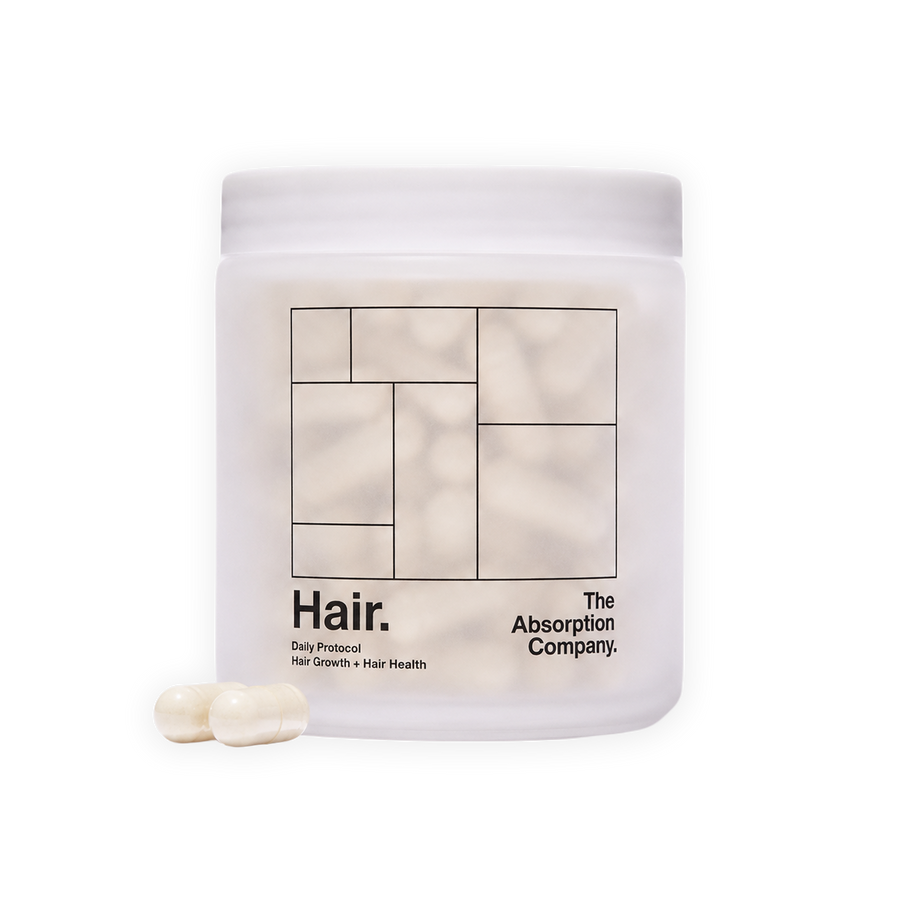
A search for a Nutrafol alternative often starts with a practical question: can I find a hair supplement that better fits my budget or routine? That is a reasonable comparison to make, but price alone cannot tell you whether two formulas are equivalent or appropriate for your type of hair concern. Ingredients, product versions, evidence, and daily use instructions matter too. This guide helps you compare The Absorption Company's Hair with the particular Nutrafol formula you are considering, using criteria you can inspect rather than a predetermined winner. Enter your own current prices in the workbench, review the complete labels, and keep any diagnosis or treatment decision with a qualified healthcare professional.
Name the hair concern before comparing supplements
A wider-looking part, more hair in a brush, and shorter broken strands can be different observations. A shopping quiz or ingredient checklist cannot reliably establish their cause. The American Academy of Dermatology explains the distinction between excessive shedding and hair loss, and why a dermatologist can help identify which is occurring. The distinction matters because the next useful step may be an examination, a discussion of recent illness or stress, or evaluation of an existing treatment rather than a new supplement.
Before comparing products, write down what you have noticed and when it began. Include whether the change is diffuse or patchy, whether there is scalp discomfort, and whether a medicine, illness, restrictive diet, or major life event preceded it. These notes are for a clinical conversation, not a way to diagnose yourself from a website. Sudden, patchy, painful, or otherwise concerning changes deserve professional assessment rather than a long wait for a product's advertised timeline.
You can still compare practical features while arranging that assessment. Keep the product decision provisional until you understand the relevant concern. A lower monthly cost is valuable only if the product is suitable; a convenient capsule count does not address a scalp condition that needs different care.
The refill price prompts a closer look
Imagine that the renewal price of a hair supplement has become harder to fit into your budget. You want to compare Hair, but you also want to understand what would change besides the price. Start by selecting the exact Nutrafol product and checking its current formula, rather than copying an ingredient list from an older review.
In the workbench, enter each product's price and labeled daily servings. Compare capsule count, ingredients you care about, and whether cited research concerns the finished formula or an individual ingredient. Mark dietary requirements as essentials and convenience features as preferences. A formula that misses an essential requirement should not become your choice simply because its calculated cost is lower.
Use the result to identify one remaining question before switching, such as an undisclosed ingredient amount or a renewal term. Keep the cause of your hair concern in view; a clearer shopping comparison does not replace an assessment of new or concerning changes.
Choose the exact Nutrafol formula and version
Nutrafol has multiple products, and the brand name alone does not define one ingredient panel. Its current Women Advanced product page describes a formula for women ages 18–44 and states a four-capsule daily routine. The page also identifies the current formula as vegan and explains that biotin was removed from that formula. Older comparisons that describe every Nutrafol option as a biotin-and-marine-collagen product can therefore mislead shoppers.
Choose the exact comparator in the workbench: product name, version if available, package size, and date checked. A formula for one life stage is not interchangeable with every other formula in the range. Likewise, evidence on an earlier formulation should not silently become evidence on a reformulated one. If the manufacturer explains continuity between versions, read that explanation and identify which ingredients and endpoints were actually studied.
Apply the same rule to Hair. Use its current Supplement Facts and directions, and retain a photograph when your package arrives. If you bought an older version or a retailer has older inventory, compare the product you would actually take. Being precise about versions makes the comparison fair to both brands and keeps an apparently simple ingredient table from concealing meaningful differences.
Compare ingredient details rather than ingredient counts
A longer ingredient list is not automatically a stronger formula. Start by separating vitamins and minerals from botanical extracts and other ingredients. For each item relevant to your decision, record the labeled amount, form, and any standardization the manufacturer provides. A plant name without extract details may not match the preparation used in a study. Two formulas can share a familiar ingredient while supplying materially different preparations or quantities.
For botanicals, check the full ingredient description rather than assuming that the same common name means the same evidence. A brand may use a specific standardized extract with its own research. That information can be useful, but it still does not establish that the complete blend has been tested against another complete product. If amounts are grouped within a proprietary blend, mark the individual quantity as undisclosed rather than estimating it from the order of the ingredient list.
Review the capsule shell, allergens, and other ingredients as well. These details can determine whether you can use the product comfortably and consistently. Put your own requirements into the comparator as explicit criteria. For example, a dietary restriction can be essential for one person and irrelevant to another. There is no need to turn every difference into a universal ranking of quality.
Understand what nutrient support can reasonably mean
A nutrient has a normal role in the body; that does not mean more of it improves hair in someone who already has enough. The AAD's treatment overview explains that confirmed nutrient deficiencies can inform a dermatologist's recommendations. This is a different situation from choosing large amounts of iron, zinc, or biotin simply because thinning hair is upsetting. Testing and clinical context should guide a suspected deficiency rather than a front-label promise.
Biotin deserves particular care because it appears in many hair products and older comparisons. The NIH Office of Dietary Supplements notes limited evidence for hair, skin, and nail claims and warns that supplemental biotin can interfere with some laboratory tests. Tell the clinician and laboratory what you use before testing; do not invent a universal stopping interval from an online article. The appropriate instruction depends on the test and your circumstances.
Also review overlap with other supplements. A multivitamin, beauty gummy, and hair capsule may repeat nutrients even when the packaging looks unrelated. ODS notes that excessive selenium can itself cause hair loss. This is a concrete reason to compare amounts across your whole routine rather than interpreting a high percentage of Daily Value as a higher chance of success.
Ask whether the research tested the formula or an ingredient
Product evidence sits on several levels. A laboratory mechanism can explain why an ingredient is interesting. A human study of a standardized extract can provide information about that ingredient. A controlled trial of a finished supplement can address that exact formula in the people enrolled. A head-to-head trial can compare two products directly. Those designs answer different questions, so the phrase 'clinically studied ingredients' should not be read as if it means all four levels have been established.
A 2018 randomized, placebo-controlled Nutrafol Women's study evaluated an oral supplement in women with self-perceived thinning hair over six months. That is relevant product research, with a defined population, formula, duration, and comparator. It is not a direct comparison with Hair and should not be used to rank today's entire product ranges. Look at the complete publication and current formula information before transferring its findings to a different bottle.
Hair's current page presents clinical results attributed to ingredients within the formula. Read that wording carefully. An ingredient result should remain attributed to the ingredient and study rather than becoming a guaranteed outcome for every buyer of the blend. In this guide, no percentage improvement or absorption multiplier is used to declare one brand clinically superior to the other.
Read hair outcomes in the units actually measured
Hair density, shaft diameter, shedding counts, growth rate, and a participant's perception of fullness are related but different outcomes. A study that measures one cannot automatically support a claim about all the others. Ask whether the result was measured objectively, assessed by an investigator, or reported by participants. Each can offer useful information, but a good comparison keeps the measurement visible rather than collapsing everything into a phrase like 'more growth.'
Check the comparison behind a result. An improvement from a participant's starting point is different from an improvement beyond the change in a placebo group. Duration matters as well: a result at the end of a study does not promise a change by a specific week for a new customer. The characteristics of the participants, other treatments allowed, and the number who completed the study all affect how confidently you can apply it elsewhere.
Photographs need similar care. Lighting, part placement, hair length, styling, and camera position can alter how full hair looks. A compelling before-and-after pair is not equivalent to a controlled comparison. If you keep your own photos, make the conditions consistent and use them to support a professional discussion. Do not treat every visible difference as proof that a particular supplement caused it.
Put absorption claims in the right place
Delivery technology can be a relevant formulation feature, but an absorption result is not itself a hair-growth outcome. Higher measured blood exposure to one ingredient does not prove that an entire formula produces more hair growth, works for every cause of thinning, or is equivalent to another product at a lower labeled amount. The necessary clinical claim must match the endpoint the research actually measured.
Ask what was compared, in whom, and under what conditions. A specific ingredient preparation compared with an unformulated ingredient is not a comparison of Hair with Nutrafol. A general statement that only a fixed percentage of all supplements is absorbed is also unhelpful: nutrients and formulations behave differently. Avoid converting a product's price into 'absorbed dollars' using a single universal absorption rate. That arithmetic gives a false sense of precision.
In the workbench, formulation evidence can be a criterion with a source note rather than a numerical performance score. For example, you can record whether human evidence on the relevant preparation is available and whether it measures absorption or hair outcomes. This approach leaves room to value formulation research while preserving the uncertainty that matters to an actual purchasing decision.
Compare the daily routine honestly
The current Hair product page directs two capsules daily with a meal. The current Nutrafol Women Advanced page describes four capsules daily. That is a practical difference worth displaying, especially if swallowing several capsules is difficult or you already manage a complex routine. It does not establish that two capsules are stronger, that four are excessive, or that the ingredient amounts are equivalent.
Look at capsule size, meal directions, storage, and your ability to follow the routine when traveling or eating away from home. A bottle that stays in a cupboard because the routine is awkward is a poor practical fit, regardless of attractive ingredient descriptions. If you have difficulty swallowing, ask the manufacturer or a pharmacist about the specific product. Do not assume capsules can be opened, crushed, or mixed into food without checking.
Keep convenience separate from efficacy when using the criteria comparison. You may reasonably give capsule count more weight than another shopper does. Someone else may prioritize a particular studied formula or dietary requirement. Making these priorities explicit helps you understand the tradeoff without disguising a personal preference as an objective medical ranking. The tool should reflect your criteria, not tell you which concern matters most.
Use your own prices to compare ongoing cost
Prices vary by package, subscription, retailer, and promotion, so the workbench asks you to enter the offer you are actually considering. Start with the number of labeled daily servings in the selected container and its total price. Divide price by daily servings to get a daily cost. Multiply by 30 for a clearly labeled 30-day estimate. This provides a consistent basis even when one package is described loosely as a monthly supply.
For an arithmetic example only, a hypothetical $60 container providing 30 daily servings costs $2 per day and $60 per 30 days. A hypothetical $75 container with 45 daily servings costs about $1.67 per day and $50 per 30 days. These are invented examples to explain the calculation, not current brand prices. The higher-priced container in this example has the lower daily cost because its supply lasts longer.
Then check the recurring terms. Does the first shipment cost less than later refills? Are shipping charges included? Is a longer prepaid commitment required? Keep optional extras separate unless you would otherwise purchase them. A cheaper alternative to Nutrafol should be described as cheaper under the entered offer and serving assumptions, not cheaper for every shopper or proven to deliver equivalent results.
Check suitability before committing to a long routine
Botanical formulas are not automatically appropriate simply because they are sold as supplements. If a candidate contains ashwagandha, for example, NCCIH describes medicine interactions and safety considerations, including concerns relevant to thyroid conditions and rare reports of liver injury. Review the complete formula with a healthcare professional when you take medicines, have health conditions, are pregnant, or are breastfeeding. A life-stage marketing label does not replace individualized advice.
A useful review includes every supplement and over-the-counter product you take, with their actual ingredient panels. Mention planned laboratory tests because of possible interference from ingredients such as biotin. Also tell the clinician why you are considering the product and how your hair concern has changed. That information helps them assess the full situation rather than answering a vague question about whether 'hair vitamins' are safe.
If you are already using a prescribed or recommended treatment, do not stop it to create a cleaner supplement experiment. Ask how any proposed product fits the existing plan. The FDA explains that dietary supplements are not approved for safety and effectiveness before marketing. Product availability and polished packaging are therefore not substitutes for evidence or a suitability review.
Turn the comparison into a clear next step
Use the workbench to list the exact Hair and Nutrafol versions, then enter current prices and mark the criteria important to you. Include evidence type, disclosed ingredient details, capsule count, dietary requirements, and cost. Leave anything unverified as unknown. An unknown should become a question for the manufacturer, not a zero that makes one formula look artificially weaker. Review the source notes beside any clinical or formulation claim.
The outcome may be a shortlist rather than a purchase. You might decide to ask a dermatologist about the cause of shedding, request a current label, or clarify a subscription price. These are useful outcomes because they resolve the uncertainties that matter. If Hair fits your priorities, visit its product page to review the current details and directions. Choosing it should rest on those specifics rather than a promise to outperform another brand.
Keep a written record of why you chose a product and what you intend to review later with your clinician. Focus on whether the formula remains suitable, whether the routine is manageable, and how your underlying concern is being assessed. A supplement decision can be thoughtful without being certain. Clear expectations protect your budget and help ensure that attention to hair wellness does not delay care for the reason your hair changed.
Your questions, answered.
Is Hair a proven equivalent to Nutrafol?
A direct equivalence claim would require relevant comparative evidence. Shared ingredients or different capsule counts do not establish equivalent effectiveness.
Which Nutrafol formula should I compare?
Use the exact formula and version you are considering. Current Women Advanced, other life-stage products, and older formulations should not be treated as one identical label.
Does Nutrafol always contain biotin?
No. The current Women Advanced product page explains that biotin was removed from that formula. Check each exact product's current label.
How many capsules does Hair require?
The current official page directs two capsules daily with a meal. Confirm the directions on the package you receive. Capsule count is a convenience feature, not proof of superiority.
Can biotin affect blood tests?
Yes, supplemental biotin can interfere with some laboratory tests. Tell your clinician and laboratory what you take and follow their specific instructions.
How do I find a cheaper alternative to Nutrafol?
Compare the actual offer price per labeled daily serving, then calculate a 30-day estimate. Include recurring terms and evaluate suitability and evidence before price alone.
A closer look starts with a source.
Read the study or official reference behind the guide. The intervention, participants, and measured endpoint matter.
- Current official Hair product page
- Current official Nutrafol Women Advanced product and FAQ
- AAD: Hair loss or hair shedding
- AAD: Hair loss diagnosis and treatment
- NIH ODS: Biotin consumer fact sheet
- NIH ODS: Selenium consumer fact sheet
- Ablon and Kogan 2018: Randomized trial of Nutrafol Women's Capsules
- NCCIH: Ashwagandha usefulness and safety
- FDA: Is it really FDA approved?
For education and everyday planning. Follow your product label and discuss individual health needs, medications, or pregnancy with a qualified clinician.